Chapter 1
How heat moves, and how we measure it
Conduction
Through a solid or still fluid, from hot to cold, by molecular contact.
Q = k A ΔT ÷ L
Convection
Between a surface and a moving fluid. Forced by a blower, or natural, driven by buoyancy.
Q = h A ΔT
Radiation
Electromagnetic emission from every surface, even through vacuum.
Q = ε σ A (T⁴ − T∞⁴)
Three measurements behind every result
- Heat input
- An electric heater set by a variac. Voltmeter × ammeter gives the power: Q = V × I.
- Temperatures
- K-type thermocouples at known positions, read by the temperature indicator or data acquisition.
- Flows
- Orifice meter for air, rotameter or measuring jar and stopwatch for water: heat carried = ṁ × cp × ΔT.
Which apparatus teaches what
Conduction
- HMTC07 Heat Transfer through Composite Walls Apparatus
- HMTC13 Thermal Conductivity of Metal Bar
- HMTC11 Thermal Conductivity of Insulating Powder
- HMTC12 Thermal Conductivity of Liquid
- HMTC14 Thermal Conductivity of Solids by Guarded Hot Plate Method
- HMTC16 Heat Conduction in Gases & Liquids
- HMTC04 Heat Transfer in Lagged pipe Apparatus
Convection
Heat exchangers
Chapter 2
Conduction
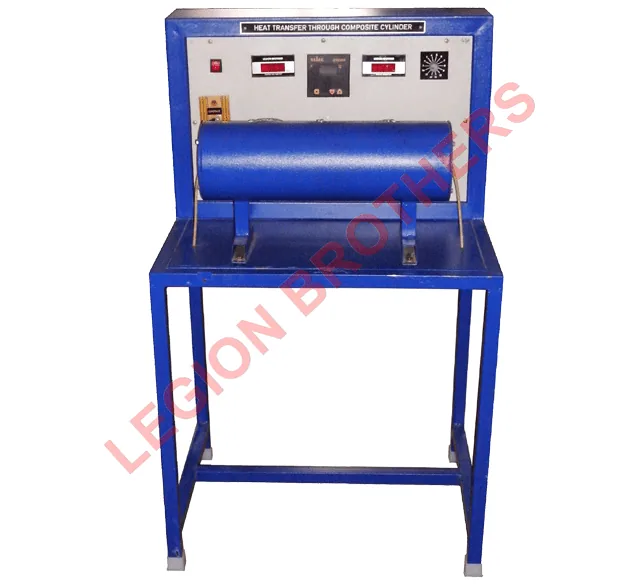
Heat flowing through layers in series meets each layer's thermal resistance R = L ÷ (k A), just as current meets resistors in series. The composite wall apparatus (HMTC07) stacks three 6 mm slabs, 150 mm in diameter: brass, mild steel and asbestos. Change the layers or temperatures and watch where the temperature drops.
- Heat flow
- 37.5 W
- Interface temperatures
- 119.9 °C and 119.6 °C
The same idea gives thermal conductivity in the other conduction apparatus. Measure Q and the temperature drop across a known thickness and solve Fourier's law for k. For the lagged pipe (HMTC04) and other cylinders the path is radial: k = Q ln(r₂/r₁) ÷ (2π L ΔT). For spheres such as the insulating-powder apparatus: k = Q (r₂ − r₁) ÷ (4π r₁ r₂ ΔT).
Chapter 3
Convection
Forced convection in a pipe (HMTC03)
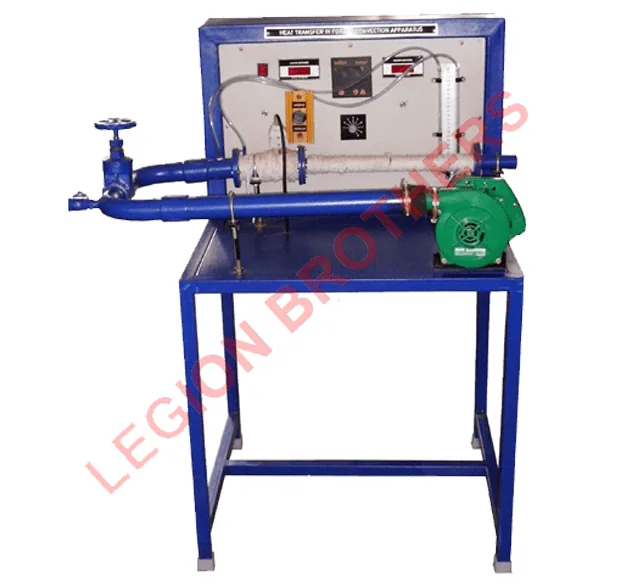
A blower drives air through a heated copper tube (25 mm ID, 400 mm long). The heat picked up by the air, divided by the tube area and the wall-to-air temperature difference, gives the measured h. Compare it with the Dittus–Boelter correlation for turbulent pipe flow, Nu = 0.023 Re0.8 Pr0.4.
Your readings
Air properties taken at about 40 °C.
Air velocity
v = flow ÷ area; Re = v d ÷ ν = 12505 (turbulent above about 4000)
8.5 m/s
Measured h
Q = ṁ cp ΔTair = 70.4 W; h = Q ÷ (π d L ΔT)
35.8 W/m²K
Dittus–Boelter h
Nu = 37.9, h = Nu k ÷ d
41.1 W/m²K
Natural convection (HMTC05)
A heated vertical stainless-steel tube (39 mm × 500 mm) stands in still air. Air next to it warms, becomes lighter and rises: buoyancy does the work a blower did above. Measured h = Q ÷ (A ΔT) is compared with Nu = 0.59 Ra0.25 (laminar, Ra = Gr × Pr from 10⁴ to 10⁹). Values are typically 5–10 W/m²K, against 30–50 W/m²K in forced convection. The tube is polished to keep radiation losses small.
Chapter 4
Fins
A fin adds surface area to shed more heat. Heat conducts along it while convection removes heat from its surface, so its temperature falls from base to tip. The pin fin apparatus (HMTC06) uses a brass pin, 12 mm × 230 mm, in a duct where the air can be still (natural) or blown (forced). Change h to see the effect of air speed.
- Fin efficiency η = tanh(mL) ÷ mL
- 67.4 %
- Effectiveness (vs no fin)
- 52 ×
- Heat from the fin
- 4.09 W, tip at 66.6 °C
Theory: θ/θb = cosh m(L − x) ÷ cosh mL with m = √(4h ÷ k d), insulated tip.
Chapter 5
Radiation
Emissivity (HMTC02)
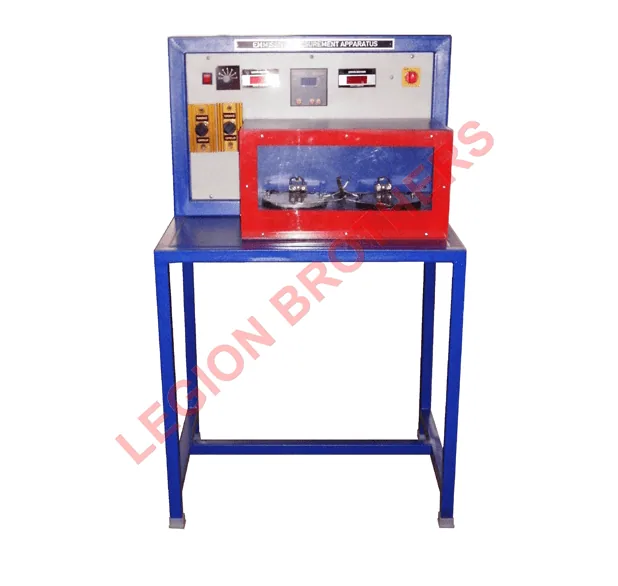
Two identical plates, one blackened (ε ≈ 1) and one test surface, get the same heater power. The test plate radiates less effectively, so it settles at a higher temperature. Comparing the two gives its emissivity: ε = (Tb⁴ − Ta⁴) ÷ (Tg⁴ − Ta⁴), in kelvin.
Stefan–Boltzmann constant (HMTC10)
A small copper test disc is placed inside a hot copper hemisphere (200 mm). The disc's rate of temperature rise, from its mass and specific heat, gives the radiation it absorbs: σ = m c (dT/dt) ÷ (A (TH⁴ − TD⁴)).
Emissivity of test plate
Equal heater power on both plates
0.72
Chapter 6
Heat exchangers
Hot water gives heat to cold water through a tube wall. In parallel flow both streams enter at the same end; in counter flow they enter at opposite ends. Switch arrangement and change the flows.
- Outlets
- hot 44.1 °C · cold 41.9 °C
- Heat transferred
- 2911 W
- LMTD
- 19.4 °C
- Effectiveness
- 56 % (parallel flow: 50 %)
In the lab: measure the four inlet and outlet temperatures and both flows, then Q = ṁ cp ΔT for each stream (they should nearly agree), U = Q ÷ (A × LMTD), and effectiveness = Q ÷ Qmax. The shell-and-tube exchanger (HMTC09) works the same way with baffles guiding the shell-side flow across the tubes.
Inlets fixed at 65 °C hot and 28 °C cold for the example; profiles from the effectiveness–NTU method.
Chapter 7
Condensation and heat pipes
Dropwise and filmwise condensation (HMTC01)
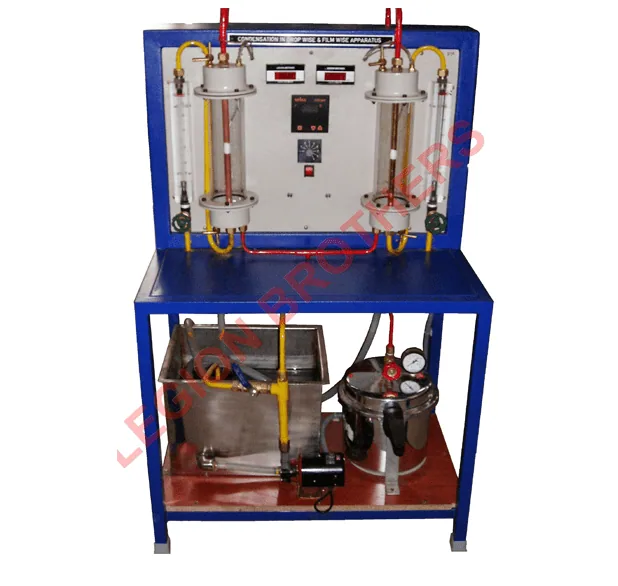
Steam condenses on two cooled tubes. On a normal surface the condensate wets the metal and forms a continuous film, which adds thermal resistance. On a treated surface it forms drops that roll off and expose bare metal, so the heat transfer coefficient can be several times higher. Measure cooling-water flow and temperature rise to compare the two.
Heat pipe (HMTC15)
A sealed tube with a wick and a little working fluid. The fluid evaporates at the hot end, the vapour flows to the cold end and condenses, and the wick returns the liquid. It moves heat with a very small temperature difference. Compare its temperature profile with solid bars to see how much better it is than plain conduction.
Chapter 8
Test your knowledge
-
In the composite wall apparatus (brass, mild steel, asbestos), where is most of the temperature drop?
Across the asbestos slab. Thermal resistance is thickness ÷ (k × area); asbestos has by far the lowest conductivity, so nearly all of the drop is across it.
-
Heater power in most of these apparatus is found from…
Voltmeter × ammeter readings. P = V × I for the resistive heater; the variac sets it and the meters measure it.
-
The convective heat transfer coefficient h is found experimentally from…
h = Q ÷ (A × ΔT). Newton's law of cooling: heat transferred divided by surface area and the surface-to-fluid temperature difference.
-
Which dimensionless number decides whether flow in the forced convection pipe is turbulent?
Reynolds number. Re = v d / ν; above about 4000 pipe flow is turbulent and the Dittus–Boelter correlation applies.
-
Natural convection is driven by…
Density differences caused by heating (buoyancy). Heated air near the surface becomes lighter and rises; the Grashof and Rayleigh numbers describe this.
-
Increasing the air velocity over a pin fin…
Lowers fin efficiency but increases the heat it removes. Higher h removes more heat, but the fin tip gets cooler relative to the base, so the fin is used less efficiently (η = tanh(mL)/mL falls as m rises).
-
In the emissivity apparatus, with equal heater power, the grey plate runs…
Hotter than the black plate. It radiates less efficiently, so it must reach a higher temperature to lose the same power.
-
Radiation heat transfer depends on temperature as…
T⁴ (absolute temperature). Stefan–Boltzmann law: q = ε σ A (T⁴ − T∞⁴), with temperatures in kelvin.
-
For the same flows and inlet temperatures, a counter-flow heat exchanger compared with parallel flow…
Transfers more heat — it has a higher effectiveness. Counter flow keeps a more even temperature difference along the length, so the cold outlet can even exceed the hot outlet.
-
Why is dropwise condensation of interest?
Its heat transfer coefficient is several times higher than filmwise. Bare metal between drops is exposed to vapour; in filmwise condensation a continuous liquid film adds thermal resistance.
Answers
- Across the asbestos slab
- Voltmeter × ammeter readings
- h = Q ÷ (A × ΔT)
- Reynolds number
- Density differences caused by heating (buoyancy)
- Lowers fin efficiency but increases the heat it removes
- Hotter than the black plate
- T⁴ (absolute temperature)
- Transfers more heat — it has a higher effectiveness
- Its heat transfer coefficient is several times higher than filmwise